
Data-minded
I want to know how I slept, not what a wristband guessed.
You have worn the ring, the watch and the strap, and each one told you a different story about the same night.
None of them could see your posture or where the weight sat.
You want the reading from the thing you were actually lying on.
What answers it
Sleep reports
Reports are built from your nights on your mattress, not from other people and not from a wearable. The left and right halves are read separately, so a couple gets two.
On the AI Pro XII, and the AI Pro VI.
Night sequence, 06:30, wake, she lies on her side, his head end lifted 8 degrees while her side stays flat, contact pressure at its lowest, a slow wave under her side, first light in the room.
What a wristband cannot see
A wearable sits on your wrist and infers the rest of you. It can count movement and guess at sleep stages, and two of them on the same arm will disagree about the same night. What none of them can see is the thing you care about: your posture, where your weight sat, when you turned and what the bed did about it.
The AI Pro XII reads from underneath. The air in each of its twelve chambers is the sensor, six a side, and pressure in each one changes as you move. That is a direct reading of the body on the mattress rather than an inference from a wrist, and it is taken every night without you wearing, charging or remembering anything.
What the report shows
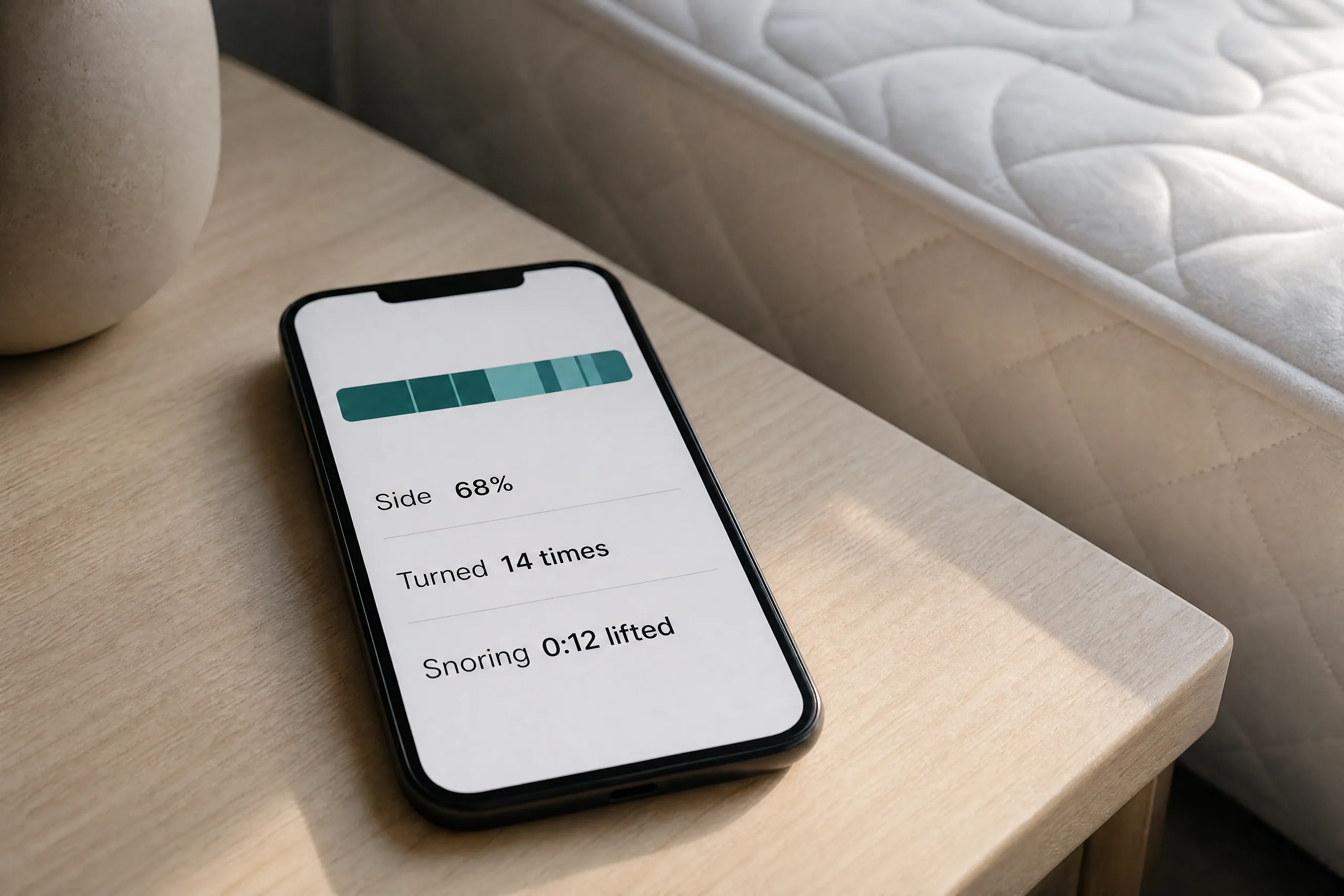
The report is built from your nights on your mattress, not from an average of other people. It shows how much of the night you spent on your side, how many times you turned, and when the anti-snore lift happened and for how long. A typical night reads something like side 68 percent, turned 14 times, snoring lifted for twelve minutes. The left and right halves are read separately, so a couple gets two reports, not one blended one.
Because the same readings drive the mattress, the report is also a record of what the bed did: where it firmed, where it eased, when it settled you in the first twenty minutes, and the light point in your cycle it chose to wake you at. You can read a night and see the mechanism. Put the fitting results next to the first month of reports and you have two things nobody had before: what your body needed, in numbers, and what the bed did about it, night by night.
What it is not
It reads pressure. It does not read your pulse, and it does not claim to. Whether anything beyond pressure is measured, and what is stored and for how long, is written on the technology page in plain language, and where a figure is not yet confirmed that page says so rather than guessing. If you are the kind of person who wants that page before the product page, it was written for you.
It is also not a medical device, and a run of bad nights in the report is a reason to talk to a doctor, not to change a setting.
Control
The AI Pro XII runs fully automatically or from the remote and the app. Every one of the eight things it does overnight can be overridden: set a firmness per side and hold it, switch float mode on or off, set the wake window or turn the body-clock alarm off entirely. The AI Pro VI runs the same way on six chambers.
What the fitting checks
The fitting is the first data point, and you keep it. The scan measures pressure distribution on a display you can see, spine alignment as a lumbar dip in degrees, body proportions and pillow height, in about three minutes for the mattress and pillow together. Then we walk you through the readings while they are still on the screen, which is the longer and more useful part. A sample fitting reads: side sleeper 70 percent of the night, peak pressure at shoulder and hip, 11 degree lumbar dip, broad shoulder with a lighter hip, 12 centimetre contour pillow.
Bring your questions about what is measured and what is not. We would rather answer them at the showroom than have you find the gaps later, and the answers do not change depending on whether you buy.